|
| Blog |
 |
| Archive |
|
|
|
|
| Blog |
| To find an archived article, simply click on Index and scroll the subject titles, or do a Ctrl-F search |
TALLRITE BLOG
You can write to me at blog2-at-tallrite-dot-com |
||||||||||||||||||||||||||||||||||||||||||||||||||||||||||||||||||||||||||||||||||
| For some reason, this site displays better in Internet Explorer than in Mozilla Firefox | ||||||||||||||||||||||||||||||||||||||||||||||||||||||||||||||||||||||||||||||||||
| April 2006 | ||||||||||||||||||||||||||||||||||||||||||||||||||||||||||||||||||||||||||||||||||
|
||||||||||||||||||||||||||||||||||||||||||||||||||||||||||||||||||||||||||||||||||
|
|
||||||||||||||||||||||||||||||||||||||||||||||||||||||||||||||||||||||||||||||||||
ISSUE #124 - 30th April 2006 [226]
|
||||||||||||||||||||||||||||||||||||||||||||||||||||||||||||||||||||||||||||||||||
|
The stories coming out of Zimbabwe just keep getting relentlessly worse. Over two years ago I wrote a despairing post about the degeneration of a once-wonderful, prosperous country. It seemed then it could never get worse. But it has, thanks to the ruthless, inexorable exercise of power and incompetence by its illegitimate tyrant Robert Mugabe. According to South Africa's Institute for Security Studies, and others, I reported in 2003 that -
Beyond the president's own charmed circle, the economic collapse knows few frontiers, least of all class boundaries. From ordinary, working class black Zimbabweans to middle class white retirees living in gracious houses, all are suffering similarly. None have income that allows them to buy the food they need; a few are lucky enough to have overseas relatives who send them money. The only real difference between these two extremes is that the whites still have possessions that they can sell off to buy food - their once-generous pensions having been inflated away to, effectively, nothing. It is a pitiless process of unemployment and semi-starvation and disease which is slowly killing people and has so far forced over three million to emigrate. Over a million children have lost one or both parents to AIDS in a child population of nearly six million. President Mbeke of South Africa, for reasons of, I suppose, African solidarity understood only by himself, continues to support and bankroll Mr Mugabe, while most of the rest of Africa holds its tongue. Fidel Castro also chips in a bit, on the basis of, presumably, “the enemy of my enemy is my friend”. Most of the rest of the world long ago stopped lavishing money on the regime, yet it still survives, through squeezing till the pips squeak whatever resources remain unplundered, and partially on aid still gallantly provided by charitable agencies. Short of a military invasion and forced regime-change (which arguably would be the most compassionate action the West could possibly take), there remains one device that the West has singularly failed to use, and that is moral suasion. Public figures should mount a campaign to make clear at every opportunity that the way Mr Mugabe is behaving towards his countrymen, whether black or white, is intrinsically evil, morally inexcusable and utterly unacceptable - as well as being unconstitutional. The word “pariah” is sometimes used about him, but there is a distinct lack of determination and constancy in denouncing his immorality for what it is. Mr Mugabe is a proud man, convinced of his righteousness, surrounded by people who for 26 years have been telling him how wonderful he is, so of course he believes them. If there is one thing he cannot stand it is being told he is wrong, a supreme insult. That is the reason he needs to receive a constant barrage of such insult in an effort to shake his confidence. But there is a further weapon so far unused, and that is the one wielded by the Pope. For Robert Mugabe is a staunch Roman Catholic. “I am a faithful, practicing Catholic”, he said at Pope John Paul's funeral last year. Forget that his two youngest children were born out of wedlock, and that he dumped his (dying) first wife to marry one 40 years younger. In the scheme of things, these are minor mortal sins compared with his systematic rape and strangulation of the citizens of Zimbabwe. If ever there was a case for the formal and public excommunication of a prominent person, surely this is it. For in permitting Mr Mugabe to remain a Catholic, the Pope is demeaning the whole Church. Moreover, for such a vain and publicly devout person, excommunication would strike him to the heart in a way that no other action would. The insult would be unbearable. And if you think, who's going to pay attention to the Pope, reflect on Stalin's mocking question, “how many Divisions does the Pope have?”. Stalin got his (posthumous) answer when, without a shot being fired, his malign Soviet Union and its empire disintegrated in ignominy, in 1989-91, thanks in very large measure to the moral pressure from Pope John Paul throughout the 1980s. Roman Catholic Archbishop Pius Ncube of Bulawayo, Zimbabwe’s second-largest city, who has urged Zimbabweans to “kick him [Mugabe] out by a non-violent, popular mass uprising”, is the ideal person to start the excommunication ball rolling. He is a brave and tough man. If anything is likely to make the president moderate his behaviour, it is surely a parchment from Pope Benedict XVI advising him, in Latin, that due to his gravely sinful conduct over many years, he is no longer a member of the Roman Catholic Church. The ultimate public humiliation. Go for it, Benny!
Gallipoli Through Turkish Eyes My Turkish friend Murat Ersavci, whom I first knew as ambassador to Ireland and later to Oman, is now Turkey’s ambassador to Australia. As part of Anzac commemorations earlier this month, he used Australian newspapers to muse on the Turkish perception of the April 1915 Gallipoli landings, reaching a readership of 2½ million. Because Russia’s access to the open seas via the Baltic had been closed off by a
Stiffly opposed by the Turks under the legendary commander Mustafa Kamal, the invasion was an utter failure that cost over 250,000 lives on each side, with Australia and New Zealand suffering a disproportionate share. Both Churchill and his First Sea Lord Jackie Fisher, each a legend in his time, resigned amid mutual acrimony. (Fisher died in ignominy some years later, but Churchill of course resurrected himself in the Second World War. Fisher recently regained notoriety when he appeared in a judgment on the Da Vinci code - see Quotes below) Gallipoli commemorations in the West (notably Anzac Day) thus focus on the tragic loss of so much youth for no obvious benefit. There is nothing for them to celebrate. From the Turkish perspective, however, Murat points out how Gallipoli is fundamentally different, though the casualties were similar. Despite the fact that the First World War ultimately defeated and destroyed the Ottoman Empire, Gallipoli represented not only a famous – albeit costly – military victory for the Turks, but provided the spur to the unification and foundation of today’s Republic of Turkey.
In 1915, Turkey, the invaded nation, was engaged in a life-and-death struggle for national survival. For more than a hundred years, Western powers had discussed partitioning it into a European and an Asian component. Turkey by then seemed, even to its own people, to be a dying nation and memories of glorious military triumphs of the past were distant. Millions of people had been driven out of their homes in the Balkans and fled under most arduous conditions, without possessions, to safety in Turkey. About half of Turkey's present population are indeed descended from the survivors so the memory is very vivid. (Of course from the Western viewpoint, this ethnic cleansing represented the reclamation of the Balkans from Ottoman conquerors in the 14th and 15th centuries.) For the beleaguered Turks of 1915, therefore, Gallipoli was one of the moments when the danger of national extinction was at its greatest, which is why they fought so hard. A seminal byproduct of their success in repelling the invaders was the birth of Turkish national consciousness, whilst simultaneously it produced a military leader of genius in Mustafa Kemal, or Ataturk (“father of the Turks”), as he later became known. He went on to win further victories against invading armies in Anatolia five or six years later, which were also crucial to national survival and paved the way to the creation, by Ataturk, of modern, secular Turkey. For he proved to be a political genius as well as a military one. Ataturk always recognized Gallipoli as a turning point for Turkey, and it is to his eternal credit that he honoured not only the Turkish dead but equally the dead of his then enemies.
Was there ever a more gracious victor? Never again, says Murat, of the Battle of Gallipoli. Its lessons remain valid today, even though it is now receding into a fairly distant past. War is tragic and heroic, but it is also futile, brutal and unnecessary. Commemorating the dead and all that the armies suffered, on all sides, helps prevent us from forgetting that truth.
Our eclipse tour of Egypt turned out to be all I had hoped for, and more. At the start of our adventure, our appetites were whetted by a glimpse of the great pyramids at Giza before trekking across the Sahara Desert in a convoy of 4x4 jeeps, staying overnight at the legendary Siwa Oasis. This is where Alexander the Great consulted the Oracle who allegedly told him that he (Alexander) was the son of Ammun Ra and therefore a divine son of God and rightful ruler of Egypt. I have a silver coin of Alexander bearing his portrait and wearing the Lion Head-dress, with Athena seated on the reverse. We got out of bed in the (very) early hours of 29th March, the day of the eclipse, and proceeded to the plateau from which we would view the event. It lies near the town of Saloum, on the border with Libya. When we got there, we found people everywhere, from all corners of the earth, setting up their telescopes, laptops and cameras, chatting excitedly, getting comfortable; the atmosphere was like a carnival. Initially, the morning weather was not hopeful with sea mists swirling about, but these quickly cleared with the steadily rising sun. First contact came at 11:20 am and it took an hour or more for the moon to encroach across the entire face of the sun. At 90% cover, the excitement mounted as the sun was
slowly
reduced to a hairline.
The hairline broke up into Baileys Beads as the last rays of the sun shone through the lunar valleys. And as the last tiny point of light disappeared, a brilliant diamond ring flashed into view. A glance to the right as the moon's shadow bore down at the speed of Concord to engulf us.
Quick photos, a look around to see a 360 degree horizon bathed in sunlight whilst the rest of the land has become cold and dark. All too soon it is over with the re-appearance of the diamond ring and the sequences played out in reverse: just 3 minutes and 50 seconds, in perfect conditions. If I never get to see the pearly gates of Paradise I know I have seen the next best thing.
I have been using Squawkbox for a couple of years to provide a comments facility after each post. Apart from a few hiccoughs, it's worked OK, although I've never liked it that much, mainly because it doesn't allow commenters to preview their comments before publishing. But it caused me so much grief to set it up the first time, that I was always loath to change it. Now, however, events have left me behind. Instead of me sacking Squawkbox, Squawkbox has sacked me. It had been advising that it would go out of business, though not until 31st December 2006. But it appears to have pre-empted itself, without warning, and vaporised into the ether. Squawkless, it has provided no means for its (paying) customers to preserve their accumulated comments, which are thus also gone. With this issue of the Tallrite Blog, therefore, I have switched to Haloscan, which seems to have superior functionality. Please bear with me if I have teething problems.
Quadruple
Quandary
for the Dear Leader Shortly after midnight, the gates opened, as they had so often done before, and a couple of swarthy looking gentlemen slipped out without a word and disappeared into the night. They pilfered some supplies for breakfast from an all-night corner store and headed to meet their colleagues in a rundown warehouse in the East end of London. They were warmly greeted, in many different tongues, by the men (and a few women) who had made the self same journey over the preceding few years. They numbered over a thousand, and the two newcomers wondered at the omerta that had meant they had never been betrayed as they plotted for the dénouement that was to come. Moreover, the no-questions-asked manner in which each had been released was matched only by the no-questions-asked manner in which each had been able to enter surreptitiously into the country in the first place. The careful series of burglaries, murders, rapes and assaults, and the inconvenient periods of incarceration that followed, had been necessary steps to assemble and train this now-full team of members. Day Nouement, as they called it, was drawing close. The planning had been meticulous. The vast majority had infiltrated themselves into hospitals and care-centres across the land, clandestinely learning the arcane arts of mouthing insincere platitudes, jabbing blunt needles into frail arms, avoiding soap, having affairs with doctors, molesting patients and complaining about pay. Once they had acquired the smart-looking uniforms, perky silicone implants, coiffured wigs, skin-whitening creams and immaculate make-up, they became indistinguishable from the genuine exponents. Late at night, they would gather inside the warehouse and practice booing and heckling in that curious way a well brought up gal does when she is pretending to be a football hooligan, which since many of them were in fact male football hooligans in disguise - and foreign ones at that - was not so difficult. But there were specialist operators as well. One of the bravest had volunteered to get close to - in fact to get to “know” (in the Biblical sense) - one of the enemy's chief lieutenants, a particularly revolting specimen known, for his meatiness, as Briskett. For two long years, she had endured his halitosis, clammy hands, outsize belly, BO, inarticulate endearments and, of course, that “fate-worse-than-death”, never once letting her blonde wig slip, even beneath the Ministerial desk, even when Briskett tried to strangle her, Daily, in front of the Mirror, as worry-lines Traced across her Temple. Other suspiciously well-tanned specialists had acquired plummy accents, and were given substantial budgets to implement their subversive plans. Their task was to use the funds to suborn the higher echelons of the regime. In exchange, they would be granted unprecedented accolades, law-making abilities and fur-lined cloaks. Apparently such baubles are much sought after for they instantly elevate you to the most rarefied reaches of society. Though these manoeuvres were conducted with the utmost secrecy, word of them got out ahead of Day Nouement, which spoiled the effect a little, though did not divert from the overall objective. At last Day Nouement itself arrived. 27th April. Or twenty-seven-four as it would thenceforth be known. All at once, they put it about that all
1,023 of them had got out of prison scot-free, and instead of being peremptorily
deported, which is the proper privilege of every foreign crook, had
disappeared into the community,
After this bravura performance, no-one would trust the state ever again to protect the security of the nation. The newspapers and TV loved it. Another example of the incompetence and chicanery of the Dear Leader. Give that man a peerage, the journalists said. He may not have made a loan but by God he made our day. There was more. Simultaneously and as per plan, the Briskett scandal was launched, with more abusive photos, showing him man-handling the unfortunate blonde across a crowded room, assaulting her with his belly, making her remove his shirt to launder it. Journalist heaven. Yet this man was none other than the deputy to the Dear Leader himself, a veritable demi-god on earth, and indeed after his antics also a sex-god according to some.
They were solemnly addressed
by none other than the very same phony
blonde who had so recently escaped the clumsy clutches of Briskett.
Calling herself Patsy Blowit, for reasons only Briskett would
understand, she stood defiantly before the 1,022 “nurses”
whilst the TV cameras whirled and reporters scribbled in their notebooks,
with not a single one noticing the unmistakable coincidence over
numbers. She congratulated them on
the undeserved pay increases they had secured and for wrecking the
finances
How they cheered their sister to the rooftops, not a few clad of course in best ermine. And how the assembled media lapped it up in their blissful ignorance, though they tended to spell “cheer” with a j. Quadruple quandary Of course he can, because if his own future is grim and grey, the future without him is a dastardly dark Brown. What could be more scary.
Week 124's Letters to the Press Only one letter this week, but it was published. Also, to my surprise, the Sunday Times published last week's “Probing Sue Lawley” letter even though it was a week out-of-date.
Iran's Supreme Leader Ayatollah Ali Khamenei threatens
that Iran will retaliate He seems to forget that Iran is already doing everything
it can Quote: “It took too long, but it is a good step on the right direction. It could be a springboard for the stability of this country …We pin a great hope on the formation of a new government. It must heal our country's many wounds.” Hussein
Farij and Majeed Hameed, two Iraqis in Baghdad,
Tenth Report of the Independent Monitoring Commission, April
2006. Quote: “I can't discuss the judgment, but I don't see why a judgment should not be a matter of fun.” Justice Peter Smith, the London high court judge Italicised
letters within the judgment spell out Apparently
this decodes to Admiral
Jackie Fisher (1841-1920), adulated by Judge Smith, However,
having presided over Quote: “He was a boastful, arrogant, nasty pig. He just jumped on you when he felt like it at a party. He had no manners whatsoever.” Tricia McDaid, who
worked with John Prescott during the 1990s,
|
||||||||||||||||||||||||||||||||||||||||||||||||||||||||||||||||||||||||||||||||||
| See the Archive and Blogroll at top left and right, for your convenience | ||||||||||||||||||||||||||||||||||||||||||||||||||||||||||||||||||||||||||||||||||
ISSUE #123 - 23rd April 2006 [258]
|
||||||||||||||||||||||||||||||||||||||||||||||||||||||||||||||||||||||||||||||||||
|
The Political Danger of Too Much Ideology-Free Centrism Margaret Thatcher was an ideological visionary who changed 1980s Britain, the sick man of Europe, forever and had a lasting effect on the rest of the world. The essence of her vision was that individuals should on the one hand be allowed freedom to act as they wished within the confines of the law, and on the other hand be held accountable for the consequences of their actions, good or bad. She reckoned that once that particular penny had dropped, people would tend to make decisions that improved their lot in life and the opportunities for their children. The bad outcomes of wrong decisions would mean people would make rapid corrections, whereas providing safety nets for wrong decisions would only encourage more of them. An integral part of this individual freedom and responsibility was the reduction of the role of the state so as to leave citizens with more of their own income to make their own decisions about businesses and services. All this was the essence of Right-wing Conservatism. But it was the antithesis of the Socialism that gripped the Communist world and the socialistic tendencies of many Western countries for most of the 20th century. After the second world war, otherwise enlightened democracies such as Britain operated a system whereby the state confiscated high taxes from earners, ran loss-making nationalised businesses, provided everyone with many essential services free of charge (medical care, education), and made welfare payments to all those on low/no income; the bonhomie spread to making wild promises of state pensions for all which it then failed to fund. Predictably,
On the other hand, this socialist modus operandi made people feel very good because everyone was being taken care of regardless of personal situation or conduct; it all seemed very humanitarian and cuddly. However what it was really doing was infantalizing adults. The State became an all-forgiving Daddy, who always clothed and fed you despite your silly behaviour, but in return he was a strict Daddy who demanded obedience and an awful lot of your money if you had any and weren't able to hide it. In the further spirit of Daddy-knows-best, those high taxes were accompanied by obsequious deference to labour unions and intrusive government regulations. To varying degrees, this is what Leftism epitomises to this day and, amazingly, many people are still proud to espouse it. Though Mrs Thatcher's vision was Rightism, to be truthful she left a lot of Leftist shibboleths in place, even enhancing them, notably a free health service and free education. Notwithstanding this, it is no wonder she argued that “no theory of government was ever given a fairer test ... than democratic socialism received in Britain, yet it was a miserable failure in every respect”. That her programme of low-taxation, privatisations, union emasculation and deregulation gave rise to a massive economic boom, that continues to his day under Tony Blair's (albeit somewhat wobbly) stewardship, is unmistakable. As is the influence she had around the world, as other countries - not least Ireland - have emulated some or all of her example. And yet ... The problem with forcing people to accept the consequences of their own behaviour is that, although on the whole their lot undoubtedly improves, statistically, some of them will always end up at the bottom of the heap. No-one would deny that society should render to those with physical or mental disabilities whatever assistance they need to live meaningful and contented lives. However, vast numbers are also suffering, but as a result of their own foolish actions and decisions. Thatcherism would advise against rendering similar assistance as it rewards that behaviour, but this seems on the face of it very unkind and so people back off. This reluctance to be harsh means that degrees of socialism have crept into all capitalist economies; in other words they have moved towards the centre. Similarly, the success of Thatcherism has meant Left-wing parties have also moved towards the centre. This is nowhere more apparent than in the home of Thatcherism where the distinguishing mark of Tony Blair's left-wing New Labour has been its adoption of more centrist policies. Indeed that is what made it electable in 1997 after 18 years in the wilderness. Lately, however, with the Conservatives' election of the telegenic, touchy-feely David Cameron as their new leader, they too are shifting decidedly centrewards, embracing more of the socialist agenda of free everything for everyone, convinced that that is the only way they can reclaim power. This belief by both parties (and also widespread in other democracies) that the majority of the electorate populate the centre ground, neither too Rightish nor too Leftish, may well prove mistaken, with unintended results. No matter the popular trends, there always seem to be a smorgasbord of minor parties hanging around the Left of the spectrum, such as Liberal Democrats, Greens, Workers, Communists and so forth. These constitute a useful safety valve, providing a political home for those of Leftish persuasion who are not happy about the mainstream move towards the middle. The choice on the Right, however, is confined to more extreme parties, notably the UK Independence Party (pro-£ anti-EU) and the British National Party (anti-immigration). It should be no surprise, therefore, that the Conservatives have lately begun to panic at the prospect that UKIP and the BNP are on the verge of stealing their voters in large numbers. For if classic Conservatives think Mr Cameron has led them too far from the prosperity and justice that Thatcherism entails, they now have nowhere else to go, even if they are not particularly comfortable with the main thrusts of UKIP and the BNP.
I think that Britain is on the verge of witnessing a resurgence of the BNP, and to a lesser extent UKIP, which will begin with council elections in May, where the BNP are fielding 356 candidates. This will be the direct result of the Conservatives and Labour having ignored the concerns of their respective heartlands in their rush for the fuzzy, unobjectionable middle ground, and pretending that the new threat they face is nothing to do with immigration. In group denial, Britain's two big parties think the BNP's rise is all down to a
and other such guff. They are soon to learn a bitter lesson: that if you have no ideology other than to get elected, then you appeal to everyone and to no-one. Meanwhile, voters with real concerns will flock to parties that do have an ideology which at least partly meets those concerns even if much of what else they advocate is repugnant. That lesson will be learnt in other countries too. Consider France. The Islamic rioting last November, the craven surrender of the government last month over the new employment contract and the country's general economic malaise will all favour a party with a strong ideology which includes clear controls on immigration. Step forward Jean-Marie le Pen: you can be sure his anti-immigration Front National will do even better in France's presidential election next year than it did in 2002. Here in Ireland a similar trend will emerge, particularly over immigration where on a per-native-head basis it's a world leader - eight times immigrant-friendly France for example. Where the immigrant proportion for Australia and New Zealand is around 0.5% per year, the cumulative figure for Ireland on predicted trends is 15% by 2016. Yet the existing mainstream parties don't dare touch the subject. But in the year ahead it would be most surprising if a party does not emerge which will publicly address it, and it will find itself kicking at an open door. Just as nature abhors a vacuum, so voters abhor political parties with an ideological vacuum. A return to real politics is badly needed in Western Europe, with distinct, competing ideologies. Where are the new Margaret Thatchers, whether of Right or Left?
Confusion Caused By “Bad” Guys With Principles There are many well-meaning, principled people in the world. Hell, I would sometimes even consider myself to be one. Yet sometimes they can be blinded by their well-meaningness, especially when it is put on public display. One thing they cannot abide is when one of their demons does something laudable. An oft-repeated objection to America's invasion of Ira “Bad” guys aren't supposed to do “good” things. It confuses the professional do-gooders of high principle. Ireland has its fair share of this kind of petty muddle-headedness. Some recent examples.
It is odd that powers of reason can abandon some people when it becomes apparent that their opponents are in fact men and women of high principle. In fact, you may be inclined to conclude that principle often deserts the objectors.
What Happened to That Pentagon Plane? As we all know, there were four IslamoNazi outrages on September 11th 2001.
Or did it? I hate conspiracy theories - they're usually just too complicated and outlandish to deserve a second thought. The CIA killed President Kennedy? No-one ever landed on the moon? MI6 assassinated Princess Diana? The Loch Ness monster is alive and well? I don't think so.
Watch first this video-clip of CNN's real-time on-location reporting. Then have a look at this photo-montage and try to answer the specific questions it poses, in particular, where is the Flight 77 wreckage? While you're at it, why were no bodies or even luggage found from the 64 people on board, and for that matter why does the passenger list contain not a single Arabic name? Why has no information ever been made public from the two black boxes that were supposedly recovered? And most baffling of all, if the attack was, say, a truck bomb or something else, why does the US Administration continue to say that it was a civilian plane? “Cui bono”, as Lucius Cassius Longinus Ravilla used to ask in Rome; who benefits? I have no answers. But if you have an hour or more to spare, I would recommend you go through the more extensive, more detailed evidence of the non-existent flight here. Post your explanations in the Comments box below. Late Note (August 2006):
Don't you just love the story of Sandhurst alumnus, Captain Sir Alan Mcilwraith, CBE, DSO,MC, MiD. A renowned military hero to whom the UK and Nato turn in times of trouble, he glides effortlessly from champagne reception to charity function to military meeting, raising spirits wherever he goes. Except he also has a day job working for Dell in a Glasgow call-centre. It was the spoil sports at the Daily Record who finally blew his gaffe earlier this month, revealing him as a fake. But there was great sport as the great and the good scrambled to verify his credentials. Assorted Army spokesmen, Wikipedia, Buckingham Palace, Ministry of Defence, Central Chancellery of the Orders of Knighthood, Glasgow University all checked their records and denounced him pompously. He duped plenty of people, but never took anything from anyone and generated much pleasure. We need more fraudsters like Captain Sir Alan to keep the world cheerful.
Week 123's Letters to the Press Four letters since the last issue two weeks ago week, of which the second was published.
Quote: “Long live democracy! The blood of the martyrs will not go to waste.” Anti-government protesters on the streets of Kathmandu, Quote: “I understand that our sights are also trained on Hamas ministers, not only on the police chief . Nobody who deals with terror can have immunity by any means, even if he holds a ministerial portfolio in the Hamas government.” Dani Yatom, an Israeli MP and former
boss of Mossad, The
police chief he refers to is Quote: “In public places, you're never allowed to play foreign pop or rock music. You get arrested. The first time, it's two months in prison. After that, life. People know better, so no one does it.” Mohamed Reza Ghanizadeh, a music student and Quote: “Maybe beauty is the final step to end violence and preach world
peace” The
lovely Tamar Goregian, Events
proved her wrong.
|
||||||||||||||||||||||||||||||||||||||||||||||||||||||||||||||||||||||||||||||||||
| See the Archive and Blogroll at top left and right, for your convenience | ||||||||||||||||||||||||||||||||||||||||||||||||||||||||||||||||||||||||||||||||||
ISSUE #122 - 9th April 2006 [223+198=421]
|
||||||||||||||||||||||||||||||||||||||||||||||||||||||||||||||||||||||||||||||||||
|
A couple of weeks ago I was invited to appear on RTÉ's Questions & Answers programme for a discussion of Iraq marking the third anniversary of the invasion. In preparing for it, I reviewed the current situation, using information provided during the second half of March by Donald Rumsfeld, George Bush, Mark Steyn, Victor Davis Hansen, Charles Krauthammer and the Iraqi Body Count website. I realise that, other than the last, these resources all lean rightwards, but what I drew from them was facts rather than opinions, and I find that such sources tend to distinguish between the two more clearly than leftward sources. This post, published on the third anniversary of the fall of Saddam's Baghdad, which Iraqis now call Liberation Day, sets out what I learnt and some of my own views. Justification for the War “Legality” is a slippery concept in international affairs because no legitimate (ie democratic) world authority exists which might set out what is and is not illegal. Many people see the UN as fulfilling such a rôle, but since most of its member states are themselves illicit dictatorships it is in no position to pontificate on the legality of others' actions. Saddam Hussein was undoubtedly a grievous and unpredictable danger to the world. He demonstrated this not only by
but in
If all this does not constitute a case for removal of a dictator, clearly a deadly menace to his own country and the world, it is hard to see what is. Only America had the might to effect this. Not to have done so would have constituted the same supreme moral turpitude and cowardice so shamelessly paraded by France, Germany and Russia. The Two Sides As we know, the invasion and defeat of Saddam and his regime were accomplished in a stunning military performance of unparalleled virtuoso by America and Britain, with an unprecedentedly small number of their own and of non-combatant casualties, regrettable though each of these was. The two antagonists were clear:
As we will see, this has changed completely in the intervening three years. Post-Invasion Progress By contrast, the peace - unlike the invasion - has been conducted in an unprecedentedly incompetent fashion. Nothing like the meticulous preparation that went into the military aspects of the invasion went into the civil aspects of rebuilding a shattered, demoralised country. It is shameful that none of the lessons learnt in smoothly building German and Japanese democracy and civil institutions from scratch in the 1940s seems to have been remembered by America's (and Britain's) post-war planners. As a result, bloody conflict has dragged on for three long and painful years. And America's use of torture - though miniscule in degree and quantity compared to Saddam's - is another disgrace, as is George Bush's redefinition of it so that practices such as waterboarding (near-drowning) are no longer “torture”. All this does not however make the invasion and attempted democratisation of Iraq wrong - merely that progress has been much slower and more deadly than it needed to have been. But the past three years have nevertheless seen astounding progress.
The Consequences of Withdrawal Clearly all this magnificent progress to date will count for naught and doubtless unravel if the Coalition withdraw before democratic Iraq is able to manage its own security. To understand the consequences, it is important to recognize how the nature of the two sides to the conflict has changed completely from invasion days.
Thus premature withdrawal will be viewed - rightly - as defeat, and the victorious insurgents will waste no time in setting up their Islamonazi, Taliban-style brutal theocracy. This will, however, doubtless trigger a three-way civil war, sucking in the neighbours, and eventual partition. Saudi Arabia will pitch in to help the Sunnis, Iran the Shi'ites, whilst Turkey seizes the opportunity to crush those uppity Iraqi Kurds. Iraq divided into three; almost every Iraqi a loser. To withdraw with such a scenario looming would thus be the equivalent of handing post-war Germany back to the criminal Nazis or Eastern Europe back to the criminal Soviets. Moreover, beyond Iraq itself, Islamicist terrorism would be encouraged everywhere in light of the American defeat. And it would be at least a generation before the US would have the stomach to face off the Isalmonazi threat again. But what will have become of Western liberal democracy by then? Will a Sharia Eurabia be upon us? The Choices Thus, we face a simple choice. Which side in Iraq will we support? The insurgents or the people? We do not have the luxury of supporting neither side or being against war because that is, in effect, to advocate American withdrawal which will support no-one but the insurgents against the wishes of the Iraqi majority. People like the recently rescued ungrateful hostage Norman Kember and his Christian Peacemaker Teams, by getting in the way of the Coalition and Iraqi forces who are trying to secure the country for the 12m voters, are simply giving succour to the insurgents. Indeed, by their very behaviour, most self-described “anti-war” activists are not anti-war at all. Though they would vehemently deny it, they are de-facto pro-war. And they are pro-war on the side of the insurgents, agitating for the defeat of America, its allies and the Iraqi people and promoting the kind of outcome described above. In proclaiming the morality of their anti-war cause, hatred of America takes precedence over the welfare of ordinary Iraqis in their millions - and indeed of the world's law-abiding citizens. What kind of morality is that? War is always a bad choice. But in this conundrum there are no good choices. Just bad choices and worse choices. Westerners are very lucky to have been able to enjoy for so many decades the freedoms won for us by the blood of previous generations. The people of Iraq want the same, and they won’t get it unless this war is seen through to victory over the insurgents.
Thoughts on the Murder of Traitor Donaldson
Then last December he dropped a bombshell. In an extraordinary self-outing, he declared that he had been spying, for money, on his buddies in Sinn Féin and the IRA for the British security apparatus for at least twenty years. This was a massive embarrassment, coming as it did in the context of at least three other senior Republicans also unmasked as spies:
When Donaldson made his statement, Gerry Adams said that he “was not under any threat from the republican movement”. You'd like to believe that was true, but, well ... The sisters of IRA murder victim Robert McCartney are apparently under no threat and enjoy the full support of the Sinn Féin leadership; nevertheless intimidation has driven them from their homes in Belfast's North Strand where they'd lived for forty years. It is noteworthy that in January they appealed to Donaldson to shed light on their brother's murder, which will not have endeared them to Republicans. Donaldson likewise found it prudent to leave his native Belfast, for fear some drunken Republican might take a pot shot at him on a Saturday night. So he moved to a primitive cottage, with no heat or running water, in a remote part of Donegal, apparently bereft of friends or family (who disowned him after he was outed) or (despite the Queen's shilling) money. It made me wonder about his remark that he had become a spy “after compromising myself during a vulnerable time in my life”. This smells of blackmail. Had the dastardly Brits caught him cheating on his wife (with whom he had three children); was he a closet gay? We'll probably never know, but the latter would not be a surprise. Then, last week he was brutally shot-gunned to death. Sinn Féin and the IRA each denied responsibility, so quickly that you'd almost think they had their statements prepared in advance. Moreover, Gerry Adams “condemn[ed] without reservation the murder”, which Sinn Féin has steadfastly refused to in the case of Garda Jerry McCabe who was murdered during an armed IRA robbery 1996. So who killed Donaldson? His long career in espionage means he will have had Republican enemies measured in the hundreds, men convinced that their operations were ruined, or their colleagues imprisoned, fined or indeed killed, as a direct consequence of his 20 years of breathtaking treachery. The fact that Messrs O'Callaghan, Carroll and Scappaticci seem to have got away with the same thing will only have inflamed their anger. There must be massive hatred and resentment of him, and there can be hardly a member of IRA/Sinn Féin who does not heartily welcome his savage murder. Yet the IRA, in an official capacity, looks an unlikely suspect because if caught the peace process in which it and Sinn Féin have invested so much would be seriously damaged (and the pseudo-Rev Ian Paisley would be ecstatic with relief). That leaves freelance individuals. However, it seems inconceivable that a disgruntled Republican would dare go out to Donegal with a shotgun and do the business. He would surely check that he had at least a nod from the IRA, for the risk otherwise to his own survival would be just too great to contemplate. And with such a nod, he can be sure of a certain degree of protection when and if the Gardaí ever come a-knocking. Furthermore, Donaldsons's slaughter is a timely and convenient reminder that traitors may not, after all, go unpunished. A case of “pour encourager les autres”, perhaps. You have to wonder therefore what is trembling through the minds of the other three known traitors to the cause. And how many other British spies embedded within Republican organizations are still to be uncovered. Republicanism can still be a high-stakes enterprise.
My thanks to Graham in Perth for this erudite tale. Are Australia's spiders really as dangerous as they are
reported to be? You bet! At a nudist beach 100 km southwest of Sydney on Sunday, a 56 year old buck naked man saw what he took to be the nest of a deadly funnel web spider. Aware of the carnage that such a creature could cause in these, er, delicate parts, he decided to take pre-emptive action by pouring petrol down its burrow and applying a match. (No, I've no idea what you'd be doing with petrol on a nudist beach. “Be Prepared”, as the boy scouts always say.) Unfortunately the resulting explosion caused severe burns to the man's backside and legs. (And again, no, I don't understand how it was his backside rather than - to coin a phrase - his frontside which caught the brunt of the explosion. One can only conjure a vision of the middle-aged nudist crouching down by the nest and reverse-tossing in the match. Perhaps he wanted to add to the conflagration). Anyway he had to be airlifted out by helicopter. Displaying their medical genius, the airlifters observed that “the man's lack of clothing probably contributed to the extent of his burns”. The fate of the arachnid is unknown, but chuckling was heard from the direction of the burrow. And as further evidence that you shouldn't mess with these beasties, the medics were called out to the same area in January when a man saw a spider crawling up the wall of a friend's cabin, took a kick at it, and broke his leg in two places. You have been warned. Those little critters don't play games.
Week 122's Letters to the Press Four letters since the last issue two weeks ago week, of which the first two were published. Given its very topical nature, I was astonished number 3 wasn't given the priority.
Quote: “[Complete withdrawal of American forces from Iraq], of course, is an objective. And that will be decided by future presidents and future governments of Iraq” George
Bush makes clear he has no intention Quote: “I do not want to give him the dignity of a planned execution, time to say his goodbyes, eat his last meal. His comrades did not give that to my mother. Let him sit in a cold, dirty cell alone for the rest of his long days, unable to direct his rants at anyone.” Carie Lemack, co-founder of “Families of September 11” I agree; I do not support state
executions. Quote: “Sexual orientation cannot, and must not, be the basis of a second-class citizenship. Our laws have changed, and will continue to change, to reflect this principle.” Bertie
Ahern, Ireland's Taoiseach, Quote: “I have too much respect for the intelligence of Italians to think they would be such ‘coglioni’ as to vote against their own interests - pardon my rough but effective language.”
Italian
prime minister Silvio Berlusconi uses colourful language
|
||||||||||||||||||||||||||||||||||||||||||||||||||||||||||||||||||||||||||||||||||
| See the Archive and Blogroll at top left and right, for your convenience | ||||||||||||||||||||||||||||||||||||||||||||||||||||||||||||||||||||||||||||||||||
| Return to Tallrite Blog |


 German naval blockade, the
Gallipoli landings (Gelibolu in this Turkish map) were a vain attempt by
its Western allies to open up for Russia a southern maritime route through the Black Sea.
As First Lord of the Admiralty, Winston Churchill's idea was to invade Ottoman Turkey and capture Constantinople (Istanbul today).
The Allies would thus control the Sea of Marmara as far as the Bosphorus,
whilst conveniently cutting off Turkey's eastern/Asian landmass.
German naval blockade, the
Gallipoli landings (Gelibolu in this Turkish map) were a vain attempt by
its Western allies to open up for Russia a southern maritime route through the Black Sea.
As First Lord of the Admiralty, Winston Churchill's idea was to invade Ottoman Turkey and capture Constantinople (Istanbul today).
The Allies would thus control the Sea of Marmara as far as the Bosphorus,
whilst conveniently cutting off Turkey's eastern/Asian landmass. 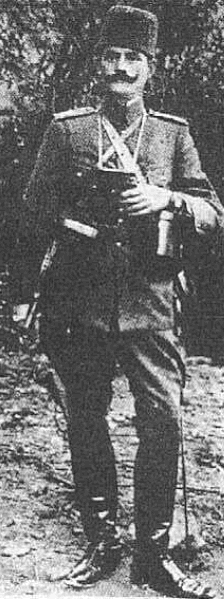 Murat
writes that as a Turk, every time he visit Gallipoli and the Straits of the
Dardanelles, he is reminded of the way in which history touches our lives,
not least in the family members he and his wife lost, such as her
great-grandfather, Major Mehmet Himmet, pictured, who died at Suvla, the
westernmost promontory of the Gallipoli peninsular.
Murat
writes that as a Turk, every time he visit Gallipoli and the Straits of the
Dardanelles, he is reminded of the way in which history touches our lives,
not least in the family members he and his wife lost, such as her
great-grandfather, Major Mehmet Himmet, pictured, who died at Suvla, the
westernmost promontory of the Gallipoli peninsular.  The
light faded and the landscape drained of colour.
The
light faded and the landscape drained of colour.
 where
they waited to pounce again. Wearing a grim expression and a smart
pair of unmatched Clarke brogues, Charlie, all whiskers, dome and ears, - for he
it was who was the Jailer-in-Chief - said he was sorry but there was no
better man than he to catch them all again.
where
they waited to pounce again. Wearing a grim expression and a smart
pair of unmatched Clarke brogues, Charlie, all whiskers, dome and ears, - for he
it was who was the Jailer-in-Chief - said he was sorry but there was no
better man than he to catch them all again.  Then came the pièce de
résistance. The annual
conference of the Royal College of Disappeared Alien Scoundrels, each
Then came the pièce de
résistance. The annual
conference of the Royal College of Disappeared Alien Scoundrels, each  of the health service, and told them that their services would be
redundant after the conference as they had now successfully subverted the
security, the health and the governance of the nation.
of the health service, and told them that their services would be
redundant after the conference as they had now successfully subverted the
security, the health and the governance of the nation. 
 The
real surprise, however, is that big chunks of white working-class, traditional
Labour supporters (
The
real surprise, however, is that big chunks of white working-class, traditional
Labour supporters (
 But
there is a serious case to be made that Flight 77 did not
slam into the Pentagon; that indeed it did not exist at all, or if it did
it came to no harm; that the Pentagon was attacked not by an aircraft but
maybe by a truck bomb. Or even a missile.
But
there is a serious case to be made that Flight 77 did not
slam into the Pentagon; that indeed it did not exist at all, or if it did
it came to no harm; that the Pentagon was attacked not by an aircraft but
maybe by a truck bomb. Or even a missile. 

 The
Republican credentials of Denis Donaldson, a one time co-prisoner with
dead IRA hunger striker Bobbie Sands, and for decades a senior and trusted
Sinn Fein apparatchik, were impeccable. His final position was as Sinn
Fein's Northern Ireland Assembly group administrator in Parliament Buildings
in Stormont, in which capacity he was a constant confidant of Gerry Adams
and Martin McGuinness.
The
Republican credentials of Denis Donaldson, a one time co-prisoner with
dead IRA hunger striker Bobbie Sands, and for decades a senior and trusted
Sinn Fein apparatchik, were impeccable. His final position was as Sinn
Fein's Northern Ireland Assembly group administrator in Parliament Buildings
in Stormont, in which capacity he was a constant confidant of Gerry Adams
and Martin McGuinness. 
Now, for a little [Light Relief]
|
|
||||||||||||||||||||||||||||||||||||||||||||||
|
Gift Idea |
||||||||||||||||||||||||||||||||||||||||||||||

Good to report that as at
FREED AT LAST, |
||||||||||||||||||||||||||||||||||||||||||||||
|
|
||||||||||||||||||||||||||||||||||||||||||||||
|
|
||||||||||||||||||||||||||||||||||||||||||||||
|
BLOGROLL
Atlantic Blog (defunct) Blog-Irish (defunct)
Jihad
Religion
Iona Institute
Leisure
Blog Directory
My Columns in the
|
||||||||||||||||||||||||||||||||||||||||||||||
|
What I've recently
But it's not
entirely honest in its subtle pro-Palestinian bias, and therefore needs
to be read in conjunction with an antidote, such as See detailed review +++++
BP's ambitious CEO John Browne expanded it through adventurous acquisitions, aggressive offshore exploration, and relentless cost-reduction that trumped everything else, even safety and long-term technical sustainability. Thus mistakes accumulated, leading to terrifying and deadly accidents in refineries, pipelines and offshore operations, and business disaster in Russia. The Macondo blowout was but an inevitable outcome of a BP culture that had become poisonous and incompetent. However the book is gravely compromised by a litany of over 40 technical and stupid errors that display the author's ignorance and carelessness. It would be better to wait for the second (properly edited) edition before buying. As for BP, only a wholesale rebuilding of a new, professional, ethical culture will prevent further such tragedies and the eventual destruction of a once mighty corporation with a long and generally honourable history. Note: I wrote
my own reports on Macondo +++++
A horrific account of:
More details on my blog here. +++++
After recounting a childhood of convention and simple pleasures in working-class Aberdeen, Mr Urquhart is conscripted within days of Chamberlain declaring war on Germany in 1939. From then until the Japanese are deservedly nuked into surrendering six years later, Mr Urquhart’s tale is one of first discomfort but then following the fall of Singapore of ever-increasing, unmitigated horror. After a wretched journey Eastward, he finds himself part of Singapore’s big but useless garrison. Taken prisoner when Singapore falls in 1941, he is, successively,
Chronically ill, distraught and traumatised on return to Aberdeen yet disdained by the British Army, he slowly reconstructs a life. Only in his late 80s is he able finally to recount his dreadful experiences in this unputdownable book. There are very few first-person eye-witness accounts of the the horrors of Japanese brutality during WW2. As such this book is an invaluable historical document. +++++
This is a rattling good tale of the web of corruption within which the American president and his cronies operate. It's written by blogger Michele Malkin who, because she's both a woman and half-Asian, is curiously immune to the charges of racism and sexism this book would provoke if written by a typical Republican WASP. With 75 page of notes to back up - in best blogger tradition - every shocking and in most cases money-grubbing allegation, she excoriates one Obama crony after another, starting with the incumbent himself and his equally tricky wife. Joe Biden, Rahm Emmanuel, Valerie Jarett, Tim Geithner, Lawrence Summers, Steven Rattner, both Clintons, Chris Dodd: they all star as crooks in this venomous but credible book. ACORN, Mr Obama's favourite community organising outfit, is also exposed for the crooked vote-rigging machine it is. +++++
It is really just a collation of amusing little tales about surprising human (and occasionally animal) behaviour and situations. For example:
The book has no real message other than don't be surprised how humans sometimes behave and try to look for simple rather than complex solutions. And with a final anecdote (monkeys, cash and sex), the book suddenly just stops dead in its tracks. Weird. ++++++
It's chapters are organised around provocative questions such as
It's central thesis is that economic development continues to be impeded in different countries for different historical reasons, even when the original rationale for those impediments no longer obtains. For instance:
The author writes in a very chatty, light-hearted matter which makes the book easy to digest. However it would benefit from a few charts to illustrate some of the many quantitative points put forward, as well as sub-chaptering every few pages to provide natural break-points for the reader. +++++
The author was a member of Britain's V Force, a forerunner of the SAS. Its remit was to harass Japanese lines of command, patrol their occupied territory, carryout sabotage and provide intelligence, with the overall objective of keeping the enemy out of India. Irwin is admirably yet brutally frank, in his descriptions of deathly battles with the Japs, his execution of a prisoner, dodging falling bags of rice dropped by the RAF, or collapsing in floods of tears through accumulated stress, fear and loneliness. He also provides some fascinating insights into the mentality of Japanese soldiery and why it failed against the flexibility and devolved authority of the British. The book amounts to a very human and exhilarating tale. Oh, and Irwin describes the death in 1943 of his colleague my uncle, Major PF Brennan. +++++ Other books here |
||||||||||||||||||||||||||||||||||||||||||||||
|
|
||||||||||||||||||||||||||||||||||||||||||||||
|
After
48
crackling, compelling, captivating games, the new World Champions are,
deservedly,
England get the Silver,
No-one can argue with
Over the competition, |
||||||||||||||||||||||||||||||||||||||||||||||
|
|
||||||||||||||||||||||||||||||||||||||||||||||
|
|